
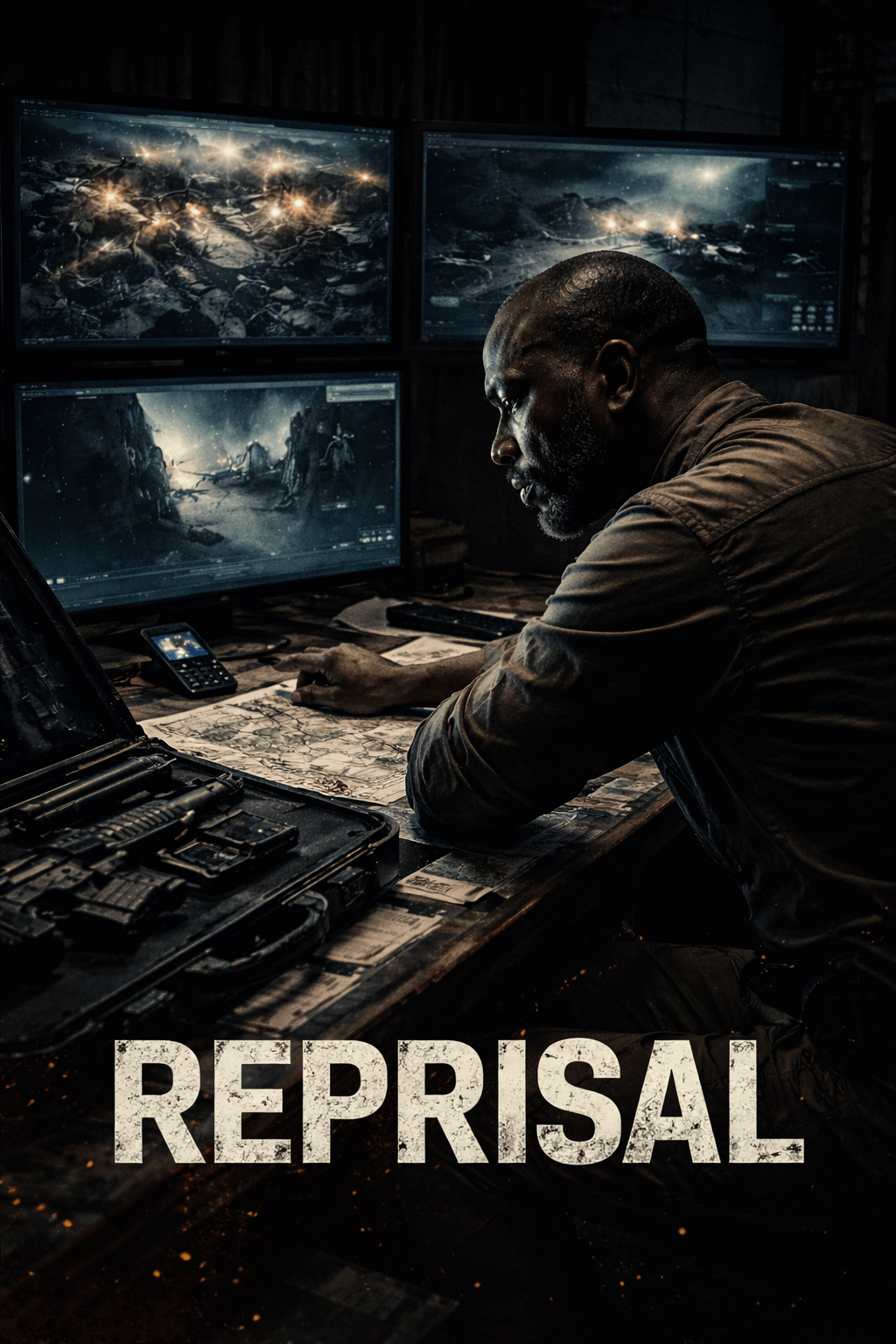
Ikenga stood in a dark office. Three screens were lit.
On one screen, he was watching a drone sweep of the raffia yard aftermath.
A dashcam feed on another, stuttering through dust and headlights.
On the third, there were clipped bodycam fragments. These were from Bravo team who never made it out. There were jerking angles, shouted warnings, and sudden static. The camera hit the earth and stared at boots that stopped moving.
He ran the sequence again.
And again.
Not to watch the deaths. To watch the shape of his failure.
His team had owned that ground on paper. Approach lanes covered. Response teams staggered. Vehicles set for containment. The depot was meant to function as a choke point, not a battlefield.
But Ogun had taken the choke point and unleashed chaos.
Ikenga paused the dashcam feed at the exact moment Charlie team went down. Ogun’s face is never in frame. Not once. His movement, always controlled. Ikenga noted it with detached respect: the discipline required to stay that invisible under pressure is unnatural.
He zoomed the drone map and traced the paths with one finger.
“This man possesses incredible focus.” He muttered. “An efficient killing machine.”
“He moves in the shadows, always off‑grid, appearing only when he chooses to.”
At the advisory, Ikenga had accepted the embarrassment in silence. One operation compromised could still be explained, surprise, leak, bad assumptions, a man having one perfect night.
The depot made it a pattern.
Patterns got men removed.
He leaned back, jaw set, eyes fixed on the footage of his men, neutralised in under four minutes. Ogun moved unlike anything he’d ever seen. No theatrics. No wasted motion. Just strike and shift. At the advisory, he’d reduced a secure facility to disarray. At the depot, he’d turned a prepared kill‑box into a corridor for his own controlled chaos.
He made professionals look like they were improvising.
Ogun is the real thing.
The secure phone buzzed once on the desk.
No name.
Ikenga let it ring twice, then answered. “Yes?!”
The voice was calm, thin, almost bored. “Does the depot’s outcome reflect your current capacity?”
Not what happened. Not what was lost.
Your current capacity.
Ikenga kept his eyes on the map. Heat pressed behind his ribs, but his voice stayed flat. “It reflects that one operator has been underestimated one time too many.”
A pause.
“Then correct it. There will not be another indulgence.”
The line died.
Ikenga set the phone down very carefully.
His hand was steady. It always was. Anger was for boys with rifles and slogans. Steadiness was for men who survived long enough to watch the slogans become contracts.
Still, he felt the insult settle in him like grit between teeth.
He knew how the Circle worked. Failure arrived first as questions. Then distance. Then the small, deliberate humiliations. The punishment came later, after they’d made sure you felt every step of the descent.
He would not be made to feel it again.
Ikenga crossed to the metal cabinet and opened it. Beneath files and cash sat the hard case he had not touched in years.
Old habits. Old certainty.
Solvent oil and metal, not spreadsheets and intermediaries.
He lifted the pistol first, checked the chamber, then the compact carbine broken in two, wrapped for travel. Clean. Oiled. Familiar. He had built his reputation before he built teams.
He looked back at the depot map.
There was a part of Ogun’s work he could not fully hate. The economy. The refusal to waste movement. The discipline to strike command instead of noise. A man like that could anchor an entire strike network. You could build reach around him. End problems before they became headlines. Make ministers kneel. Make generals negotiate.
What a weapon, Ikenga thought.
What a waste.
“If OW-T was with us,” he said softly, “he would have been a king.”
Then his face hardened.
“But he isn’t. I am.”
He called in three men, not the loudest, not the most loyal. The ones who listened before moving.
No more static traps. No militia theatrics. Ogun would expect panic, radios, checkpoints with too many guns.
So Ikenga gave him method.
Mobile teams. Silent routes. Civilian traffic camouflage. Layered intercept points that looked like accidents until they closed. Burst-window comms only. If Ogun slipped one net, he would enter the next already tightening.
Ikenga shut the case and picked it up.
By dawn, he was in the lead vehicle. The route map was folded beside him. The city thinned from black to grey and began giving up its hiding places.
He would end OW-T himself.

 The Lagos Directive
Leave a comment